IMPROVING YOUR BALANCE
How to Improve Balance
Improving your balance takes time and practice and it doesn’t just happen overnight.
However, with consistent practice, you should be able to improve your balance over time. Don’t give up practicing and trying to find your balance because if you give up hope then you will not find your balance… and so the circle goes on.
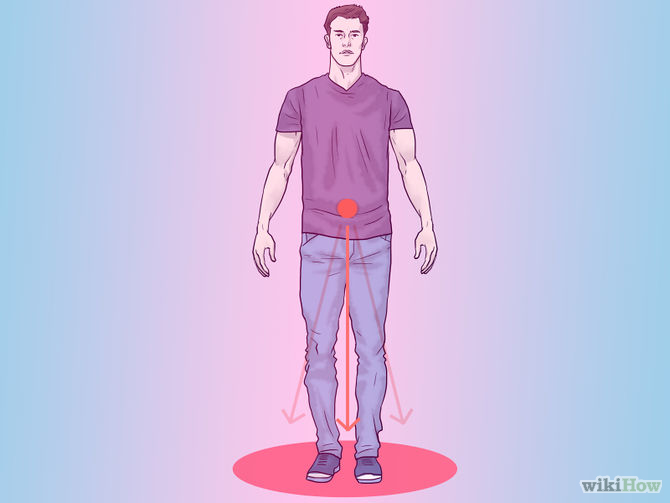 Understand how balance works. When in perfect balance, your centre of gravity will be exactly above the point where your feet touch the ground (or if there are multiple such points ie two feet, then between them).
The human body being as it is, it is impossible to remain exactly like this for long; deviations from this ideal stance will soon appear, and grow quickly (in other words, you’ll start wobbling). In order to keep your balance, you need to know when this happens as soon as possible; the deviations are easy to correct when you notice them on time, but when you notice them too late, it’ll become too difficult to return to a balanced position and you’ll fall over.
Learn how to feel your vestibular system better. 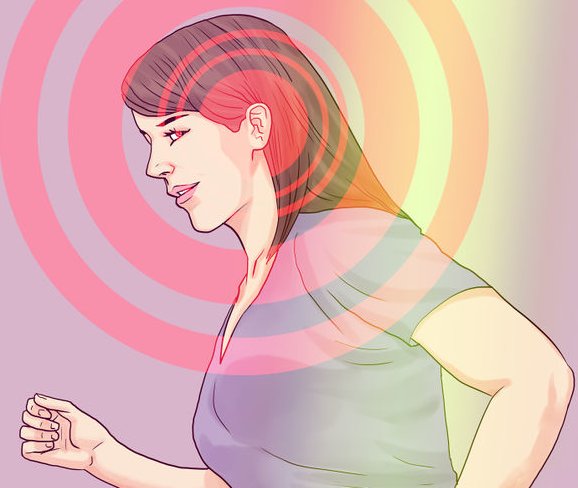 This is a mechanism in your inner ear that tells you when you start wobbling, and how much and in which direction, and is your main tool in balancing. Becoming more sensitive to it will improve your balance greatly.
Take time out everyday to practice balancing.
- To practice the feeling on your own, you can start by just standing with both feet on the ground and your eyes closed, and listening to your body. Feel how it sways slightly and corrects your stance all the time. The feeling will be most noticeable when your feet are close together. This is a good way to get to know the sensations of the vestibular system, and a good exercise to refine this sense. There will be little to no risk of falling over with this exercise, but since the feelings are rather subtle, it will require some patience and concentration.
- For a more practically applied exercise, try balancing on one leg for, say, half a minute. If you feel wobbly, try bending the grounded leg slightly at the knee.
Keeping your gaze focused on something stationary when balancing makes it easier to keep yourself stable, as this enables you to see when you are moving compared to the thing you’re looking at. How useful this visual input is depends on the distance of what you’re looking at.
- If you look at something near you when balancing, you will easily notice when you move even slightly, and adjust your stance unconsciously. If you look at something further away, like the horizon, subtle movements will become much more difficult or even impossible to see. The peripheral vision is also used for balancing reference, though, so you will only be completely devoid of visual help when your entire field of vision is filled with things distant. (Or when your eyes are shut.)
- You can use this fact to train your vestibular system gradually; try looking at something close by first, and when you notice you can easily remain stable that way, try looking at something further away. Continue directing your gaze further away as you progress.
- When you get better, try closing your eyes or wearing a blindfold during these exercises; without visual input, you will be forced to sense which way you are leaning by means of only your vestibular system.
- To develop your sense of balance even further, repeat the above steps when standing on various immovable things the top surface of which is smaller or more narrow than the sole of your foot, instead of on one leg. Look for things to stand on everywhere around you; narrow ridges, sidewalk posts, rails on fences, the back of a bench in the park, et cetera. The smaller the surface of contact between your foot and the thing you’re standing on, the more difficult it will be.
By lack of any such objects, you can also try standing on just the outside, ball or heel of one foot, instead of on the whole sole. You might find that such stances make your foot ache, though.
BALANCE TIPS
Improve your stomach muscles. Ballerinas have incredibly strong abs because engaging the stomach muscles improves the balance. Do things such as crunches/reverse crunches (sit-ups work the hip flexors, and are hard on the lower back, so avoid them) and you should notice an improvement to your balance.
Take up a sport that requires balance, such as martial arts, horseback riding, skateboarding, yoga, ballet, jazz, hip-hop, or cheerleading. Not only will you get to practice your balance, it will be fun!
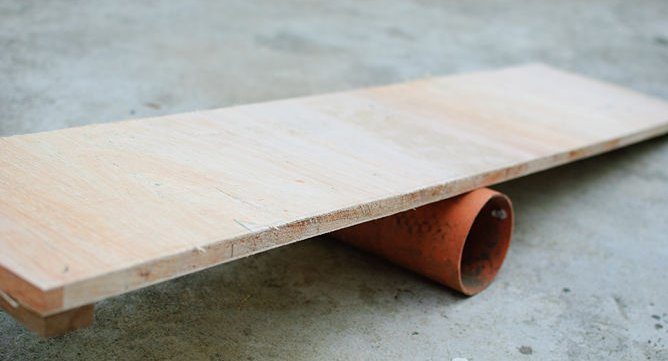 Another VERY amusing way to improve balance is to make a simple balance board.
Almost made from scrap….this gets the body going in no time.
Enjoy the challenge.
HYDRATION & SHOOTING
An article by Nick Sanders.
 When planning for the 2004 Athens Olympic Games heat was identified as a major factor in many sports, shooting was no different. One heat related issue is dehydration, which can be complex and seriously impact athletic performance. Some simple strategies implemented at the Victorian Institute of Sport (VIS) with our Olympic team were designed to minimise any adverse effects.
Is dehydration an issue?
D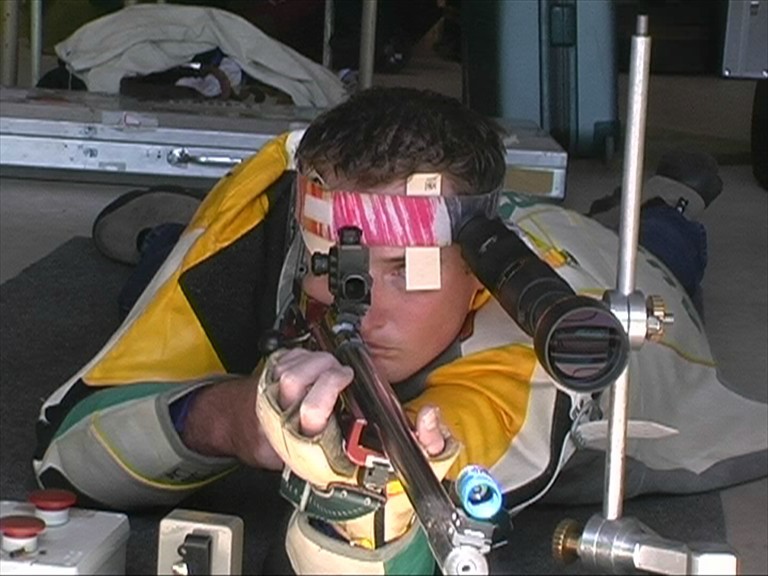 ehydration can ultimately impact on shooting performance as it causes a reduction in the circulating blood volume, which in turn can affect:
- concentration
- eye sight
- decision making
- fine motor control
- internal temperature control
- increasing heart rate
- recovery time, on either the same day or the day after
- recovery from air travel
How do we know this is an issue for our shooters?
We conducted simple field based urine tests at training and competition. Urine specific gravity was the test used and it essentially measuring urine concentration. The test works on the physiological assumption that the more dehydrated you are the more fluid the body will try to retain, ultimately increasing urine concentration. This study established that around 60% of our State and National level shooters were not hydrated.
How did we address the issue in a practical way?
The natural response is often simply say drink more water but everyone differs according to how much and when they can drink. What you don’t want is an athlete unnecessarily breaking concentration to go to the bathroom as a result of drinking a bottle of water immediately before his/her event. Similarly the athlete should avoid drinking water just before going to bed as this may result in a disturbed sleeping pattern with the need to go the bathroom during the night.
The strategies
Our study targets two aspects for enhanced absorption and retention of fluid. One of the most effective ways for us to deal with the issue was to target the hydration routine athletes undertake the evening before competition and/or training. From our research conducted at the VIS, as well as from other published research, we know that urine output after consumption is high during the first hour after drinking but this continues for another two hours thereafter.
Initially we set a volume of fluid of about 750ml (1 large drink bottle) to be consumed and finished not less than three hours before bedtime. We were then able to tailor the volume consumed individually, as people hydrate differently and loose fluid in the heat at different rates.
We also know that water is in fact a poor method of hydration from an elite sports perspective. One of the main reasons sports drinks contain carbohydrate and sodium is to assist the body to retain fluid as it passes through the stomach. The VIS has, to great effect, been using a sports drink such as PowerAde combined with a high sodium product called GASTROLYTE (commonly used to treat diarrhoea).

This fluid combination has been used to assist athletes with re-hydration after training, and competition, and any travel. The Gastrolyte and PowerAde combination is not meant to substitute for the volume of fluid consumed, but merely to assist in retaining more of the fluid consumed.
The standard measure is to drink 150% of body weight loss after training or competition still applies, rifle shooters wearing leathers can easily sweat this in an hour. In extreme cases where we find high hydration levels on the morning of competition, we also use this combination to aid in hydration immediately before competition.
The results
The impact of this type of information and the strategies designed to reduce any performance issues has been significant. Dehydration is now no longer an issue for many athletes, although there are still some grappling with the strategies, especially having to provide daily morning urine samples! It has also highlighted the importance of looking after the body more closely in combination with the specific skills of the sport.
Some practical strategies for maintaining hydration
- Thirst is a lagging indicator of hydration – if you feel thirsty, you are probably already dehydrated.
- Urine colour is a poor indication of hydration – it cn be influenced by some foods, drinks and vitamin supplements
- Set up a “night before” training/competition strategy. Establish the routine, and stick to it. Drink 750ml of water between 6 and 7pm, assuming a 10pm bedtime. After a few weeks you may feel that you can increase the volume up to 1.25ml. You will go to the bathroom frequently to start with, but it will reduce over time. A hydration level on the day of training/competition is to try and consume about 250ml an hour in the hours before the event. Some fluid will pass straight through the system, and a toilet stop before the event is normal.
- When shooting is finished, and it is hot, the use of the PowerAde and Gastrolyte combination may help lost fluids.
- If drinking to rehydrate – when you have a drink, take 3-4 mouthfuls rather than little sips. It will make the consumtion of the volume needed to rehydrate much easier.
Please note: everybody’s physiology is different, so strategies are always refined to suit the individual. These suggestions are possible ways to assist, and by no means the only ways or strict standards to follow. If you are taking any medications or health problems please make sure you consult your doctor for the best solution for you.
HOW TO TRAIN TO IMPROVE
Now everyone is going to say …. “Of course I train!… but do you…do you understand the real meaning of training.
The three processes are … TRAINING … PRACTICE … COMPETITION …
Let’s break that down a bit – TRAINING.
Training is taking the time to work on the little elements of performance, one at a time, and push for improvement. This improvement may be as a result of trying something new (trial and assessment) or simply looking at an element that sometimes gets in the way of a good performance.
This could be as simple as “when I get a bit nervous, I tend to lose trigger control” so the training element would be taking the time to work on the trigger process.
How long is this training process? How long is a piece of string! Every experienced shooter suspects their weak spots, and should focus there first.
You would be amazed at how many highly experienced shooters use training time to “refine the basics” and this could include: confirming head position, confirming reliable trigger technique, keeping the mind in focus, working with balance in the position (yes in all positions, including prone and benchrest) …. and the list goes on.
Then there is PRACTICE element.
Once the training elements have been successfully improved, it’s good to put the training work to the test, prior to a competition, and see if the training has been effective. Perhaps a control match, or the very least, a half match, putting yourself in the “competition mindset” This practice match will also show the shooter and coach where training should be next directed.
This is where the use of electronic trainers such as SCATT are valuable (Under e-trainers)
Finally there is COMPETITION
When we go to a match, or Club Open, or the State shoot, what we are doing is the Competition part, hoping that the hard work will come together on the range, at that particular time. Sometimes it does, and sometimes it doesn’t.
There are many reasons why it “doesn’t work” on a particular day, however mostly it will be linked back to the specific training elements that you have, or have not improved.
Getting nervous? Train to relax and focus
Got distracted by others? Train with noise and talking.
Getting tired? Train physically to improve endurance
The weather’s hard? Train in all weather conditions, not just the fine days
The weather’s hard? Learn from your coach, about shooting in varying conditions
Can’t see targets? Experiment in training with varied combinations of sight options
Can’t see targets? Get your eyes checked
Had “flyer shot”? Test ammo groups in training
Had larger groups for no reason? See above!
Hand gets sore/tired? Check with your coach and try variations
I could go on, but I won’t, as I’m sure you see the differences now. When you go to club night – determine if you are using the time to train, or practice. Sometimes you will need to shoot a competition for the averages, or monthly award, however there is always time to train and improve.
Enjoy the challenge
Tricia
HEARING
HEARING……. is it worth protecting????
Thoughts by Tricia Van Nus.
All shooters have been taught from their earliest days at the local club that shooting affects hearing, and that ear protection is a “must”. Most use the small mushy pellets, some have the formed plastic version in vivid colours…….and some unfortunately choose to disregard the advice and do not protect their ears at all. From the interesting and valuable resources on the website of Hearing Australia I have compiled a few notes….. food for thought…. even music to the ears!
Whatever the style of preferred ear protection, it is essential to take stock of where you are with respect to your ears and realise that it may not only be your sport that is damaging your hearing. Workplace and social activities may also contribute to a hearing loss. This hearing loss will generally happen quite slowly – often to the point where it is denied. The one sure way to find out where you are at is to attend your local Hearing Practitioner and ask for a hearing test
OK – SO NOW YOU HAVE HAD A HEARING TEST The results of a hearing test will often indicate the degree and type of hearing loss. Of course you must remember that these comments are very general – see your health care professional for more accurate advice
Degree of hearing loss (decibels, dB) What that may mean in real terms
Mild: 21-45 dB You may have some difficulty hearing soft speech and conversations but would manage in quiet with clear voices.
Moderate: 46-60 dB You would have difficulty understanding conversational speech and more so in the presence of background noise. TV and radio would be turned up.
Moderately severe: 61-75 dB The clarity of speech heard may be significantly affected and this can restrict the benefit of a hearing aid.
Severe: 76-90 dB Normal conversational speech is inaudible. A hearing aid will amplify many speech sounds. Visual cues may be necessary in understanding speech.
Profound: 91 dB + There is great inconsistency in the benefit derived from a hearing aid. Some can understand clear speech face to face in places with good auditory conditions when wearing a hearing aid. Others find it impossible.
NOISE INDUCED HEARING LOSS Exposure to excessively loud noise is very similar to exposure to ultraviolet radiation from the sun… too much can be dangerous. Around 27% of people have a hearing loss as a result of exposure to excessively loud noise. The ear does not differentiate between noise and sound. The brain does that. Noise is often defined as annoying sound. Though you may not find a noise annoying, it may be sufficiently loud to damage your hearing. Noise affects you by either just being irritating, or by actually damaging the hearing mechanisms in the inner ear.
WHEN IS A SOUND TOO LOUD?
An excessively loud noise is when you must use a raised voice or shout in order to be able to speak to someone at an arm’s length. The noise in that area is possibly dangerous.
ENTERTAINMENT & MUSIC Noise does not need to be unpleasant to cause damage. Do not imagine for a moment that only workplace noise has an effect on your hearing. Many rock musicians suffer from a disabling hearing loss. The ear does not distinguish noise produced by work activities and noise produced by leisure activities, the brain does.
ILLNESS OR INFECTION INDUCED HEARING LOSS
Some medications and chemicals may disrupt your hearing. If you use chemicals at work or at home, take a few minutes to study the instructions in the safety sheet that should be supplied with chemicals. If taking prescribed drugs, and your ears start to ring, inform your doctor immediately. Some medications have the potential to harm hearing if used over time or in high doses.
PHYSICAL INJURY Obviously actual physical injury may lead to hearing loss…. a blow to the head, damage to the neck in a car accident, or damage to the eardrum while engaging in water activities
EVER WONDERED HOW MUCH NOISE COULD CAUSE PERMANENT DAMAGE? The World Health Organisation recommends a maximum continuous noise exposure of 85 dB(A) for 8 hours per day. Hearing damage risk is negligible below 75 dB(A) so unfortunately the washing and vacuuming stays. The Sound Thermometer on the right gives you an idea on noise levels in decibels and length of exposure.
OBVIOUS PRECAUTIONS YOU CAN TAKE Avoid loud noise. It’s murder on your ears! When attending night clubs, motor races or fireworks displays – wear earplugs. Learn to fit them correctly, because poorly fitted earplugs offer little protection.
Have a set of formed ear plugs made for both shooting and loud social activities – they are moulded to your ear and offer the best protection, without diminishing the enjoyment of the activity.
Cleaning – clean your ears regularly and wipe around the outside of the ear with a damp cloth. If a build-up of wax blocks the ear canal, special eardrops available from a chemist may soften the wax. Visit your doctor in order to physically remove any blockage
START NOW
Shooting (and standing next to jets taking off) are obvious activities that could, over time, severely reduce your hearing.
Studies have shown that teenagers and young adults may be aging their ears at between 3 to 10 times the usual rate by exposing their ears to dangerously high levels of noise or music. Many will likely begin to lose their hearing in their thirties instead of their sixties. NAL, the National Acoustic Laboratories, the research division of Australian Hearing has shown that in today’s urban society everyone is at a higher risk of early hearing loss, more so than in previous generations or quieter societies. Ensure that all members of your club take an active participation in “keeping their hearing”. Insist on all visitors wearing ear protection and encourage all members to invest in correct protective devices – even those who say that their “hearing is shot” See your local Hearing Practitioner – she/he may offer special deals to club members in the interest of better hearing.
Have fun and enjoy your shooting …… what was that? ….. I SAID, HAVE FUN AND ENJOY YOUR SHOOTING
HAVE YOU TRAINED YOUR BRAIN?
HAVE YOU TRAINED YOUR BRAIN LATELY?
Changing thoughts and habits: an ongoing project…
Human beings think. We think all the time. It is a central factor in our lives; our experience of reality is shaped by the moment-by-moment flow of our thoughts. As long as we can still learn, we can change our thought habits.
Humans can acquire new thought habits, and even change or eliminate non-productive habits. One definition of Thinking is: the reception and processing of external and internal data in order to assess and interpret the world within and around us.
Of course, thinking also encompasses the much broader phenomena of human consciousness or awareness. lt is said that the human body, not only the brain, but also the nervous system and all the sensory apparatus connected to it processes more than a trillion bits of data every second.
This data is received through our senses and processed, interpreted, and put to use. New data is received, stored, and held as archival memory for later use. Familiar data is matched to the archival memory information to be understood and utilised.
Many types of practices may help athletes learn new thought habits. Lee’s focus on three: Repetition, Education, and Conversation.
Repetition
Repetition involves actively repeating new thought habits, such as mantras. In the case of athletes, they could repeat the thought habit “I believe I can do this” (or something more specific) until it anchored as an actual pathway within the brain. A coach might suggest the athlete quietly repeat the new thought habit several times daily: on waking, at midday, at the end of the day, and before sleeping.
Talking about the standing position, phrases like…. “my body is strong”….. “my balance is good”
Education
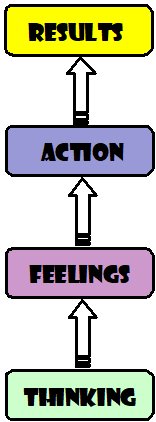
One of the answers, I believe, lives in an understanding of a deeper mechanism within us: thinking. Here is how the chain works:
As thinking occurs, feelings arise…
Changes in thinking and feelings help redefine the actions that an individual may be inclined to take…
When changes in thinking and feeling generate a change in action, a change in results becomes possible…
When a change of thinking is sustained, the probability of a sustained change in actions and results is increased…
Therefore, the more we open our mind to learn, anything is possible.
Conversation
“Coaching” is more about asking questions that help athletes discover what they want in sport and indeed life, and how to go to get it. It’s offering them ways to create something new for themselves. Once the athlete and coach have “mapped the terrain” ie worked out where they are going, and how, the conversation is based upon helping athletes to set positive goals, and then reaching those goals.
How to Improve
You are not responsible for everything that happens to you (although you may accidently contribute to it.) But you are responsible for how you react to these events, how you experience them and move on. Your reaction has three facets:
- A mental reaction, how you interpret the situation, which is often a replay of old stuff you’ve attached to as part of your memories.
- An emotional reaction that results from your interpretation, so you feel happy, angry, sad, or frustrated.
And a behavioural reaction: based on your feelings you act in a certain way…. such as jumping for joy, getting away as soon as possible, or punching the other guy’s nose.
So you create your own reaction with what you told yourself. It may have been instant and below the level of your consciousness but there was your voice inside telling you these things. Actually, though, you did have other choices.
Your inner voice can talk you into a lot of trouble or it can create a positive outlook that changes your life experience. The secret is to stay in the moment, to stay conscious, and spot your “inner voice” when it is replaying old tapes and talking nonsense, when it is being intolerant, exaggerating or over-reacting.
So my advice is: if it’s not positive, STOP, gather yourself in the moment and reconsider.
The following is a collection of possible phrases that build upon the thoughts presented.
Work out your own responses and write them down….seeing is believing.
 I am healthy and relaxed
I eat well and exercise regularly
My performances are improving
I see the benefits of my training—technical, physical and mental
I look for the positive in all that I do
I can maintain my inner balance in times of pressure
I feel grateful for everyone’s support
I feel a sense of work/life balance
I feel comfortable and positive with my life
I believe that I can do my best to reach my goals
I believe that I can accept support from my colleagues and coaches
I believe that good health = good life and it needs to be cultivated
I believe in me!
Enjoy the Challenge
Tricia Van Nus
GETTING PHYSICAL
By Tricia Van Nus.
Good health and a level of physical fitness are essential for the degree of control needed in shooting. Whatever your age, gender or size, you can be healthier for your chosen sport. Many people will say that prone is just lying on the ground – why do I need to stretch or anything? Remember that prone shooting assumes a very odd position for your body (try the “prone stance” while standing up)
If you want to be the best you can be – it’s the little things that count.
- a balanced diet
- general fitness training
- adequate rest
- avoidance of drugs, including reducing nicotine & alcohol
- shooting-specific fitness training
Stretching is essential for the shooter, and stretches should be completed before every shooting session.
Too many shooters consider that lifting the rifle case from the car is all the exercise that is required for shooting. I contend that warm muscles perform better and there is less chance of injury. Here are a selection of useful stretches for the shooter. Remember a stretch should be held for 15 seconds to fully reap the benefits.

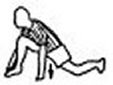
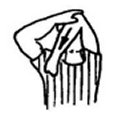
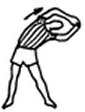

- do you eat the same type of food the day before competition
- do you go to bed around the same time
- do you taper your alcohol in the week prior to competition
FORMS OF MENTAL REHEARSAL
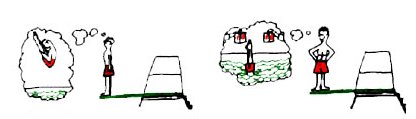
Forms of Rehearsal by Tricia Van Nus
Mental Rehearsal – This is the most common form of rehearsal and coaches use this tool to help the athlete to stay on task and reinforce the skills. This form of rehearsal has many names, visualization, imagery, and rehearsal. It is often used during the loading of each shot – just a positive reminder of what you are trying to achieve. It is simple to mentally rehearse the shot in your mind before you attempt the shot. Shooting the best shot possible, is the name of the game.
Note: When you have a really good shot….all the elements were perfect, then use that shot as a “good example” for your mind – note what you did right!
Mental rehearsal also helps to keep the mind in focus – “what I want to see, is what I’m aiming for”
Mental Practice – This is used when a shooter can’t get to the range. It is a period of time that is set aside in which an athlete will mentally shoot perhaps a 20 shot string, or even a complete match in their mind, going through every aspect that competition brings.
Some shooters will rehearse firing good shots over and over in their mind. This helps promote the likelihood that the shooter will perform this way in the future. Remember that this form of mental rehearsal must be completed in EXACTLY the same time frame, as you would shoot a match or training session.
Contingency Planning – This comes from NASA. They spend a tremendous amount of time going over what to do if things do not go according to plan so they will be ready for anything. Shooters should do the same thing and go over the possible situations mentally and physically so they know how to get out of trouble. Shooters should mentally rehearse that they are leading a tournament and run away with it…..what will my mind be thinking.
Also rehearse coming from behind and shooting the “score of the day” on the final day or detail of the tournament to win. You should also rehearse getting out of trouble and making a great recovery shot/s.
The WHAT IF list is essential. What will I do if “xxx” – no problem, as I’ve thought of this before and have a solution that works, and is practised.
Reinforcement Rehearsal – This is used to build on a player’s success. The best way to extend the success that a player is having is to mentally rehearse that success over and over. This reinforcement process allows the player to perform that way more often.
When things are going well – take in the information that makes it “so good” Understand that reinforcing good process is as important, as detecting little changes in process.
ENJOY THE SHOOT!
DRY FIRE & IMPROVE
We all have need to dry fire.
Many top Prone, Position and Benchrest shooters regard dry-firing as legitimate and valuable practice. I offer the comment though, that rim-fire rifles may well be damaged by dry-firing on an empty chamber – there is a solution.
Possible – The firing pin may hit on the edge of the chamber, pinning the chamber so that over an extended time a round can no longer be inserted cleanly or there may be a possible damage to the actual firing pin itself and /or the chamber. Firing pins are strong, however why do something that may reduce their accuracy.
Far better to have an empty shell in the chamber. The case is softer than the firing pin and absorbs the shock. But after using lots of these fired cases in shooting practice over the years, I often noticed a small quantity of a grit-like substance, something like sand in the chamber and throat of the rifle.
On tapping a few empty cases on a table it was easy to see where the grit was coming from. It contained some fouling but appeared to be a residue from the bullet case. Consequently to fire a rifle with this in the barrel would seemingly be like firing a rifle with fine sand in the barrel.
So what is the solution?
One possibility is to fully clean the brass you are going to use for dry-firing – take care as it is harder than it sounds to get them really clean and dry on the inside!!
Another solution is to apply the “tap-test” to remove most of the loose stuff inside the brass case.
Another is to use normal cases and run the cleaning rod with a patch through the rifle before your next “live-fire” shoot to remove any residue – easy solution to protect your valuable investment.
Invest in t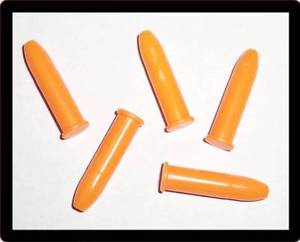 he plastic dry-fire bullets that resemble the real thing – although these are sometimes hard to obtain – check with your local firearms dealer, or look to the internet for online suppliers.
Whatever your solution, remember…..
The cases (plastic or real) will not last forever and that continual firing in the one spot make may them rather hard to extract from the chamber. After 5 shots or so, extract the plastic case and turn it around so that the firing pin will contact in a different place. Discard the plastic cases after 20 shots or so.
Use brass cases for 2-3 times only and then discard. Brass cases should be from the bullets that your rifle has fired originally – save and clean your shells
Plastic cases should be constantly checked for any sign of deterioration and then immediately discarded.
What are you trying to do when dry-firing?….
Experienced shooters hear the phrase so often, they are probably yawning right now.
However, the purpose of dry-firing is
…to train the body to accept a particular course of action over time.
…to give the muscles a chance to adapt to a particular position
…it allows the shooter to quietly work on pure technique and good process, without the distraction of scores, wind, mirage, or rain.
…to train the body so that the muscles will feel comfortable and be reliable in line with the demands of the sport
…to encourage the mind and body to work as a team in the establishment, development or maintenance of a particular shooting position.
…provides excellent “brain-training” about the process of firing the good shot
…to provide an excellent and valuable “off-range” training medium
…to sharpen the senses and improve your “feel” for the position and the rifle.
Dry-Firing Works!!!!
CORE STABILITY
WAYS TO IMPROVE CORE STABILITY
What is core stability… basically it is the capacity of the muscles of the torso to assist in the maintenance of good posture, balance, etc., especially during movement. Core stability is the name given to the strengthening of the corset of muscles surrounding the back and abdomen. These muscles are also known as the core or powerhouse muscles and provide a solid base upon which all other muscles can work upon to initiate movement
Over the past few years, there has been increasing attention to the role of “core stability” in athlete training and preparation. Being strong through the trunk is critical in both developing good posture, and preventing back soreness and injuries. With reference to sport, core stability is vital to longevity and optimal performance, and is essential for air / positional shooters and very useful for prone shooters.
Core stability training starts with the basic position:
- Start by lying on your back with knees bent
- Your spine should be relaxed on the floor, aligned normally with a small gap between the floor and your back. This is the “neutral” position you should learn to achieve
- Breathe in deeply (belly breathing) and relax all your stomach muscles. Breathe out and, as you do so, draw your lower abdomen inwards as if your belly button is going down towards the floor. Hold the contraction for 10 seconds and stay relaxed, allowing yourself to breathe in and out as you hold the tension in your lower stomach area
- Repeat 5-10 times
Once you can complete this exercise successfully, then the concept can be combined in the following ways.
Crunches
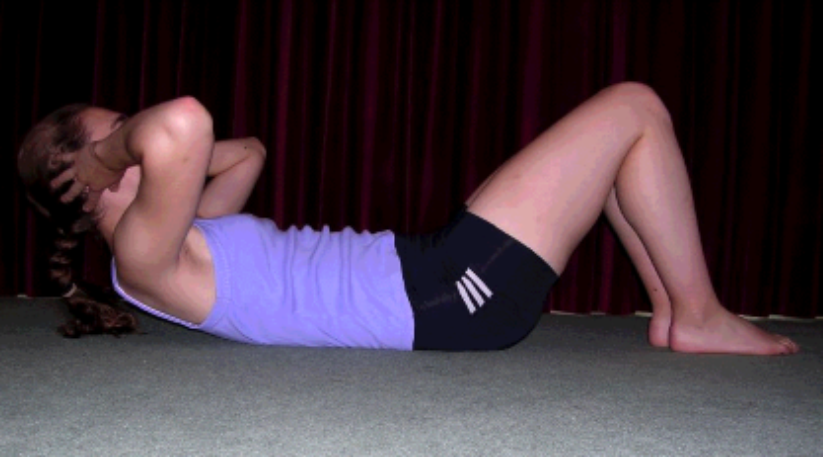 a) Lie on your back with your knees bent and your feet flat on the floor
b) “Crunch” or curl your stomach to lift your shoulders just off the floor.
Try not to use your hip flexor muscles to carry out this movement, or use your arms to pull up your head.
The Plank
 a) Assume a front-support position resting on your fore-arms with your shoulders over your elbows.
b) Straighten your legs out behind you and lift up your hips to form a dead-straight line from your shoulders to your ankles. You should be balanced on your fore-arms and toes, with your lower abdomen and back working to keep your body straight. Hold for 1minute.
Oblique Plank
a) On your side, balance on your right fore-arm with your shoulder above your
b) With your legs out straight to the left, lift your pelvis so that you are balanced on your fore-arm and feet. Your body should form a straight line and you should feel the oblique muscles down the side of your trunk working to maintain the
Hold for 1 minute then repeat on other side.
Static Leg & Back
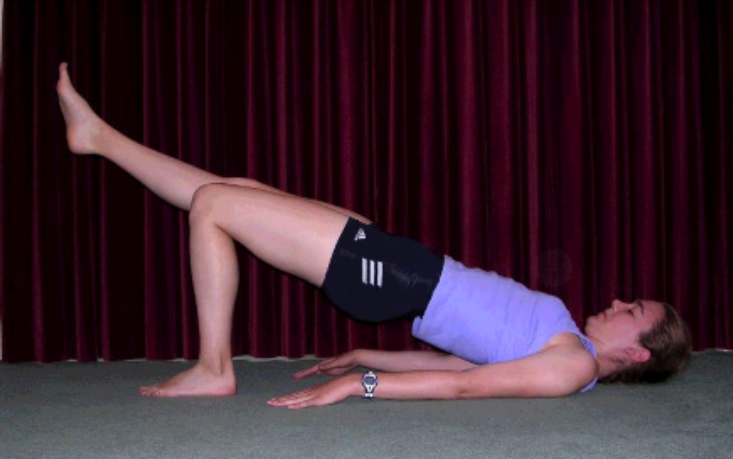 a) Lie on your back with your knees bent and your feet flat on the floor
b) Lift your pelvis so that you form a bridge position with a straight line running from your shoulders to your knees
c) Lift your right leg off the floor and extend it so that it continues the straight You should be able to feel your left buttock, your back, and lower abdomen working to keep the position.
Hold for 30 seconds then repeat on the other leg. Your hips should be level
Dynamic Leg & Back
a) Assume the same position as for the “Static leg and back”.
b) Lower your pelvis but do not allow it to tilt or touch the floor. This should be a slow, controlled movement.
c) Return to the original position, restoring the straight line from shoulders to toe
Aim to complete 10 with each leg. Stop if you feel the hamstring hurting at all.
 Swiss Balls are a great exercise tool to improve core strength and tone the entire body. They are inexpensive and widely used in back pain rehabilitation and injury prevention. Swiss Balls can help improve balance, coordination, strength, stability and posture. They are widely used by both athletes and patients and are frequently recommended by Physiotherapists.
When used correctly, Swiss Balls can also help improve sitting posture and decrease the likelihood of posture related injuries, such as headaches, back pain and neck pain.
You can’t help but be impressed with that. Try improving you core stability, and see the benefits to your shooting – whatever the discipline.
- Contact your local Physiotherapist for more information.
BECOMING AN ELITE ATHLETE
7 Steps to Becoming an Elite Athlete
Don’t assume you’re too old or out of shape to make your dream of becoming an elite athlete come true. The oldest Olympic medallist was 72! Here are steps you can take towards living your dream:
- Critically assess your physical condition
The first step is to determine what shape you are currently in. This will help you to select the best training program you will need to follow. If you are 35 years old and your favourite activity is sitting on the couch with a six pack and a bag of chips, you probably aren’t cut out to become an Olympian. However, if you are willing to make a few lifestyle changes……. You can get an assessment of your current level of fitness by visiting a local gym and consulting with one of the trainers.
- Choose a discipline
Are you interested in Air Rifle, 3P, Prone or RBA Benchrest. If you are an older athlete, you are more likely to achieve success in a sport that focuses on “mental” rather than purely “physical” strength aspects. These are the disciplines that lead to international selection.
- Find a place to train
Once you decide which discipline to pursue, you need to start developing your skills. Make the effort to attend the range whenever possible—use the best ammunition that you can afford, and make each shot worth it! Home dry firing works well also. Success comes from the level of work you are prepared to offer.
- Start competing
If you haven’t already started competing at the State and National level, now is the time to do it. It is important in many sports to build a national “ranking” by competing at certain competitions. TRA/SA is no different. Many State have a State-based ranking also.
- Get a coach
This step should be taken at the same time as you start competing. A coach can help you develop your skills, so you can progress to the next level. A coach is sounding board for you to bounce your ideas against—in essence, an essential element of successful shooting.
6. Visualize your success
A training technique used by top athletes is visualization. According to one theory, if you see a perfect golf swing 1,000 times in your mind, it’s better practice than actually swinging the golf club 10,000 times. Your coach and the internet are full of valuable information to help you learn about visualization and how it will prepare you to achieve the result you want.
- Attend the National Championships
The TRA National Championships are run in a similar format to the Olympic program, plus additional events, so it is good, high quality competition. Often, the National coaches are present and they will be happy to help or advise—or even conduct a session with you.
THE REST……. IS UP TO YOU
| TIP OF THE WEEK…. How to win a Gold medal.Take 500g of talent—add 1500g of sheer effort. Mix together carefully. Then fold 75g of luck and 400g of positive attitude into the mix. Put this mixture aside, and let it rise for a bit. Check progress frequently.This mixture will also now need a sprinkle of opportunity and approximately 300g of sheer mental toughness. This last ingredient is essential and must be added.
Your mix is now ready for the “cooking” process. Remember that the cooking may take anything from 2-5 years to reach its optimum flavour. Again, check progress constantly to prevent burn-out. Remove from container, and let loose on the competition circuit. You have a winner with this recipe. |
Enjoy the challenge
Tricia
-
SUCCESS IS A CHALLENGE