STANDING POSITION – where to start
The standing position relies on balance and utilising the body structure to support the rifle. |
For starters – stand at an angle of roughly 90° to the direction of aim, placing the feet approximately shoulder width apart.The modern (successful) trend is to have slightly more weight on the front leg with the hip pushed a little towards the target. This provides a convenient resting point for the arm supporting the rifle.
Precisely how much “hip tilt” and weight should be on each leg????….. how long is a piece of string! What can be said is that it is certainly personal to the shooter and the particular body shape and it may well change as you gain more experience, but the description above is a good place to start. The position should be comfortable, within the rules and practical. The coach will help to refine the position. |
| Hold your head as straight and upright as reasonable – your ears will thank you with a more reliable feeling of balance. If necessary, cant or turn the rifle in comfortably towards the head. The bone structure, not the muscles must support the rifle. Bend the upper portion of the body slightly backwards while pushing the hops slightly forward, so that the rifle is over the body’s centre of gravity. Experiment with this to find the spot that is just right.Use the palm rest to help keep the rifle high enough to ensure that the neck is relatively upright without disrupting the hold. There are many varied palm rests and “holds” – check out what other shooters are successfully using, and don’t be afraid to adapt or create your own. The supporting arm rests against the rib cage. The stability of the position is enhanced when a shooting jacket is used. It is also wise to complete some of your work without the jacket – this gives you the opportunity to get in touch with what is going on within your body. The shooter shown here has not yet put on his shooting jacket so you can better see the line of the body. Sight raiser blocks are often an excellent investment as the blocks life the sights just enough to eliminate the “squashed neck” syndrome. |
 |
| Olympian and Commonwealth Games Gold medallist, Tim Lowndes | |
Your coach will adjust the sights closer to your eye and lower the rifle’s butt plate to allow for appropriate height alignment and good fit into the shoulder.
 |
The butt length is often reduced to bring the weight of the rifle closer to the shooter. A sling is not used in the standing shooting, and shooting boots or sturdy shoes are essential for standing to assist the body with stability.A pair of correctly fitting shooting trousers completes the ensemble. The trousers support the lower back.
Spend time holding the rifle and setting up your position, both with your eyes open and eyes closed. Setting up without the use of your eyes, and the benefits are more fully explained in the section on shooting position |
| SPECIAL ADDITIONAL NOTES FOR AIR OR SPORT RIFLE As a palm rest is not used in Air rifle (as shown here) or if you do not use one with a Sport or Free Rifle, there are a few standard methods of supporting the rifle. |
|
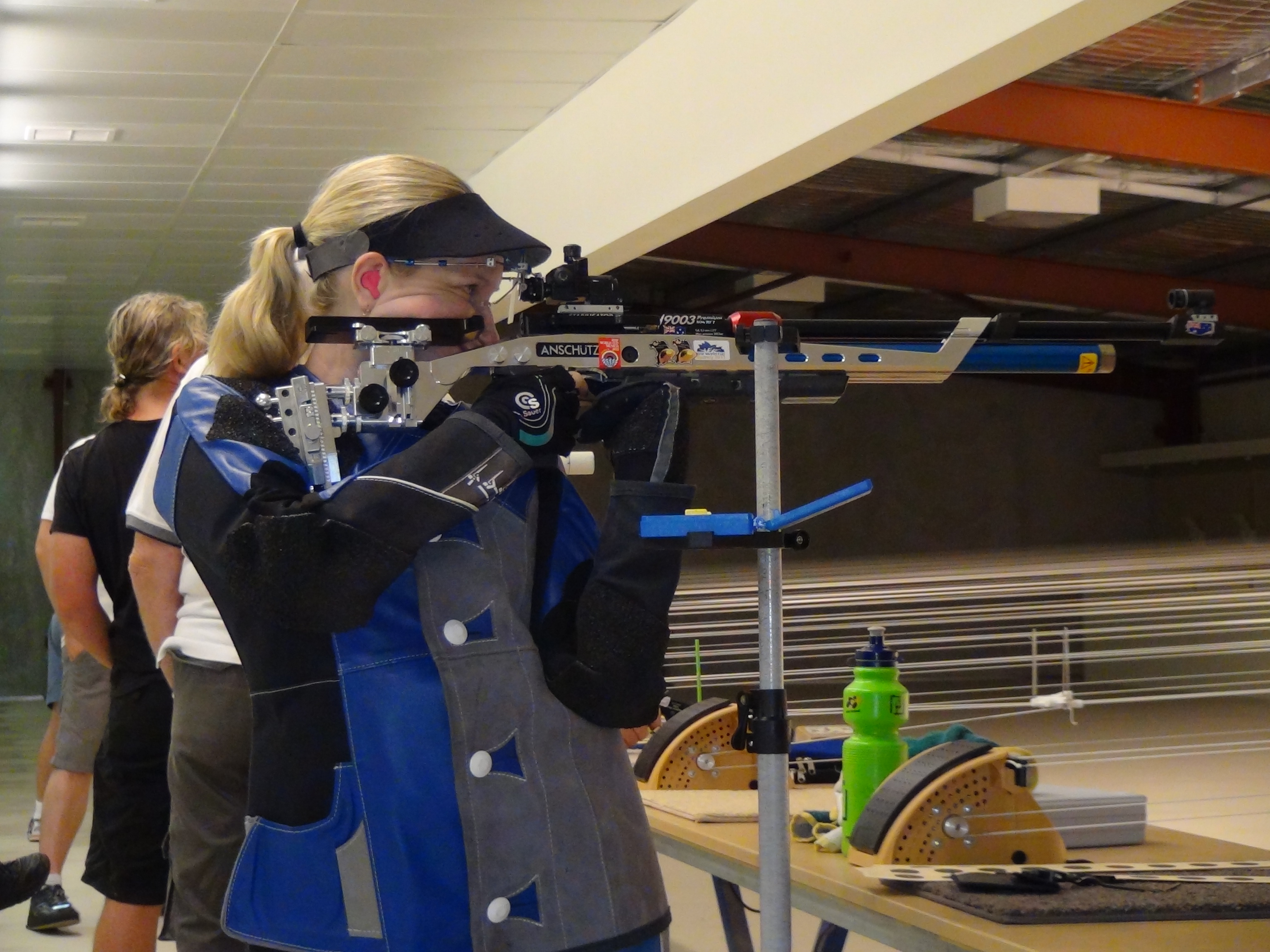 |
You can…. …. roll the supporting hand into a loose fist and support the rifle on top of the knuckles just in front of the trigger guard area, keeping the forearm, wrist and back of the hand straight and as vertical as possible. This works well for those who require the extra height to successfully reach the targets |
| Robyn Ridley – Dual Olympian and multiple Commonwealth Games team member | |
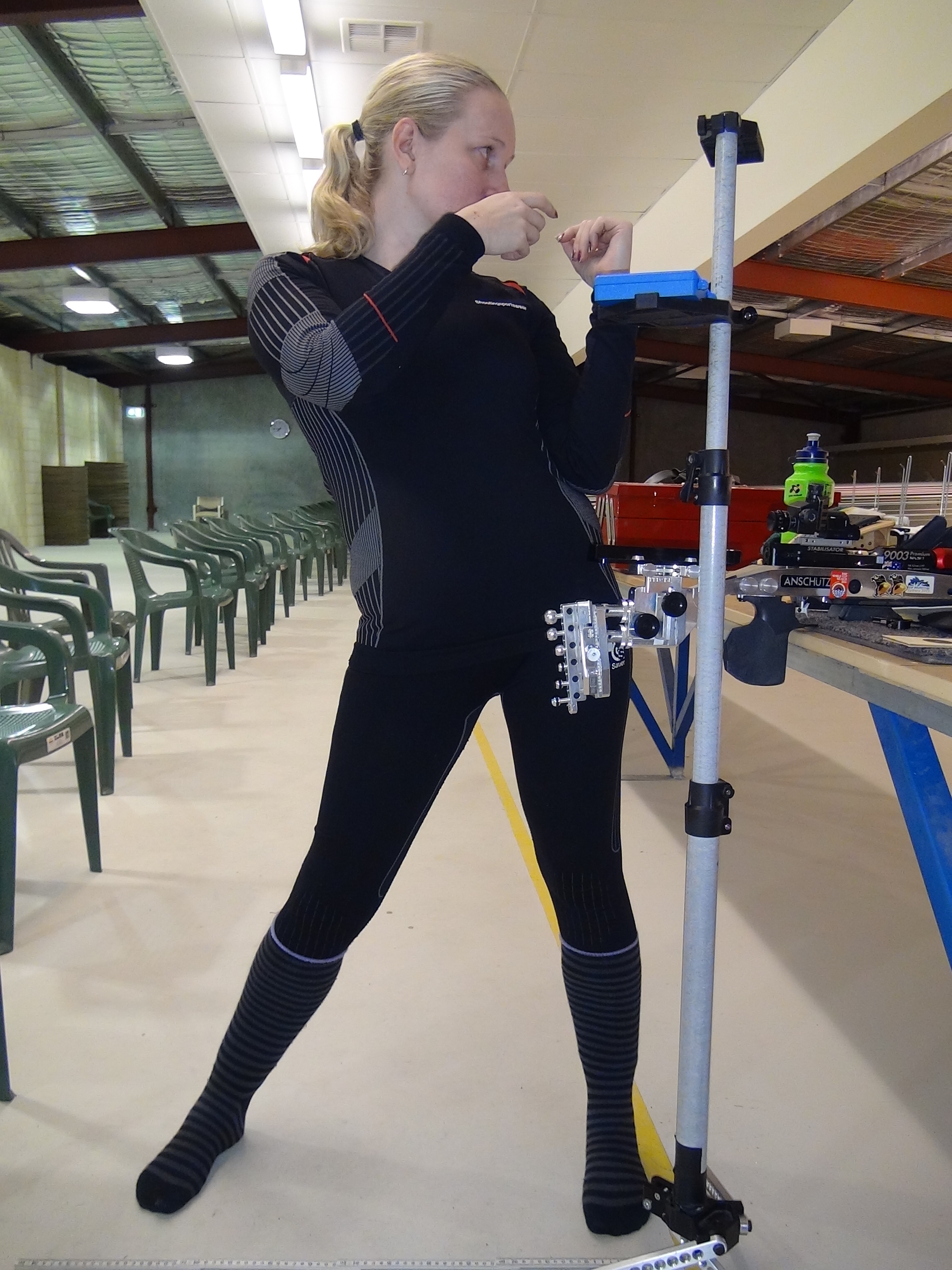 Females can often “tilt” their hips forward to the target as shown by Olympian Robyn Ridley. Females can often “tilt” their hips forward to the target as shown by Olympian Robyn Ridley.
|
…or support the rifle in the V of the hand, between the thumb and the body of the hand. Great for those who are tall and where height is not an issue. There are many variations to this sound basic position, however experimentation should only be undertaken after the shooter has some experience.Key issues of standing
Changing the direction of the feet (ever so slightly) will impact on the direction of the barrel. Get to know where your feet should be – measure the distance or draw a diagram to help you remember. Legs must be controlled, not locked tight at the knees If your boots need inserts to help your ankles, then do it The body will move – learn to recognise when you are in the “least movement” stage and use that time to complete the shot Standing is a comfortable position. Look, and talk to other good shooters for hints that you may wish to try |

SOUND SHOOTING POSITION
written by Tricia Van Nus
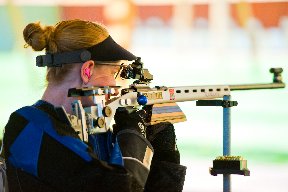 A sound shooting position is made up of a number of elements. These can be identified as: natural point of aim, consistency, balance/support, comfort, and, for every competitor, legal.
These elements are common to all shooting positions. The amount of detail may also change as a shooter’s skill increases. But the basic elements do not change.
Natural Point of Aim (NPA):
What makes up NPA and how to check NPA??? Put simply, the NPA is precisely where the rifle is pointing when you are not using your eyes to zero it to the target. The radar systems we have (ie eyes) always help guide us to the target, much like a heat-seeking missile. We can be bluffed into thinking that the body is holding the rifle on the target, when all the while it is the eyes that are doing most of the work.
Testing this out is simple and can be completed with all disciplines – Set up your position with your eyes open and really be sure that you are right.
Complete this a few times to ensure your correct position and dry fire a couple of times. Then take the rifle out of your shoulder…..breath twice…..and start the process over again….but this time do the whole thing with your eyes closed. Just before you are about to take the dry-fire shot, open your eyes and note where the rifle is pointing:
• If you are roughly on target…….congratulations!!!! Your body was indeed in command and your eyes only complement your NPA.
• If you are close to the target…..good!!! More work needed on paying attention to the little things. You can improve by working on the feel of your position.
• If you are not even close to the target…….oops!!!! Your eyes are in charge and often coerce you into thinking that the rifle barrel is pointed towards the middle. Wriggle around and more dry fire practice for you.
Consistency:
Shooters must consistently duplicate the same shooting procedure every time they assume a shooting position. Improved consistency = improved performance.
One of the keys to shooting a small group is consistency. That means consistency in everything you do. It means consistency in position of the body, the feet; consistent muscle tension in the legs, back, arms and grip; consistent positioning of the stock into the shoulder the degree of canting, and the head on the stock, even down to the clothes you wear – have your “shooting clothes” as distinct from your “normal clothes”. The entire shooting process needs to be the same from shot to shot, day to day. Everything has to be done the same way, every time. As the skill level improves, work on being able to consistently produce the new skill.
Changes that your coach may recommend need to be recorded in the diary and worked in over time so that they become part of the habit. Changes need practice so that they become consistently part of your model shot process.
Have a checklist and stick to it. When you dry-fire at home or on the range, be just as consistent with your process and position. Dry firing is the training of the body and mind to produce your best shot on demand.
Balance/Support:
For the prone and F Class shooter, support is greater than balance. For all other positions, balance is the keyword. To be in harmony with the body to produce the skill required of a position shooter (air or .22) needs work and adherence to some basic guidelines.
• A body without muscle stress will perform for longer periods at a higher level
• Positions can be achieved or reworked to promote muscle support and better balance.
• A fit body has extra reserves that can be directed to better balance.
• Balance can be practiced at home – ask your State Coach for some balance exercises, or contact the writer.
• Dry firing is an excellent way of training your muscles and your brain.
Comfort:
Comfort is important and necessary to a good shooting position. When a match is to be conducted over three hours, or even the 20 shot detail, those in pain will soon lose their ability to stay in touch with what they are doing, and moreover lose their desire to try. There should be a balance between comfort and reliable performance technique. Sharp pain in any area of the body should be investigated – talk to your coach about it and together find a solution.
Legal:
Competitive shooters’ positions must be legal that is, positions must conform to the rules for the disciplines as set by the International Federations and TRA. Check with your local ISSF or TRA Officials ……..obtain a Rule Book to be sure of your rights and responsibilities.
Now, over to you – have fun
SHOOTING STANDING
Fact: you achieve stability through balance, conscious relaxation and through the use of well fitting shooting clothing.
Fact: A stable shooting position is steadier and offers greater resistance to the shot resulting in a greater degree of accuracy.
What happens when one or more of these factors breaks down. Should, for example, and for whatever reason, a mild panic take hold during a competition, the mind will often produce negative pictures and fears rise to the surface. As with a stubborn child, a diversionary trick can often help to release this fixation.
The knack lies in captivating the mind and thoughts with a different topic – something more positive and useful. Luckily enough in the shooting sports, there are subject matters that benefit the shooting action – such as focus on breathing , body position or technical details.
The shooter who tries to concentrate on the balance and statics of his shooting position tends to forget everything negative. Try this in your next training session…..as it will not work in competition unless it is a practiced option.
Simply think of the mechanics of your next shot, the feel from within, the balance of your body, and potential bad thoughts will disappear, as of their own accord.
STANDING SHOOTING POSITION – STABILITY
The stability of your standing shooting position only affects the steadiness of your stance and hold. Remembering that this has a considerable influence on the rifle’s deflection when a shot is tired. When your stance is firm and your body parts are braced together, your smallbore rifle will not jump nearly as much, upon releasing a shot, as when your stance is too relaxed.
With an air rifle, this difference is not so noticeable, but it has an equally strong effect on your shooting accuracy. A solid shooting position “absorbs” minor mistakes, when a shot is released, because the position’s stability offers greater resistance to such impulses.
A vital factor in the stabilization of the shooting position is the shooting attire. Jackets and trousers made of stiff canvas envelope the body like a casing and thus absorb many disturbances resulting from your swaying, mistakes with the release and the recoil of the gun.
Consequently, your movements increase considerably when you shoot without a jacket, and the deflection of your rifle is far greater when you fire a shot.
TEST AND TRAINING
Shooting without a jacket or even without trousers and shoes is an excellent way to improve the stability of your shooting position. Before beginning your normal shooting, you should fire ten to 20 shots without your usual shooting garb in order to enhance your sturdiness. It is hard, yet rewarding.
Increased sturdiness is achieved through various measures, that are taken one after another so that the rifle is ultimately steady and stable.
STEPS FOR SUCCESS
- Balance: Make sure that your weight is equally distributed over your heels and toes.
- Statics: Ensure the weight is placed on your bones and joints. Muscular tension is to be reduced as much as possible.
- Breathing: Breathe deeply from the stomach and let yourself “sink together”. While you sink several millimeters in yourself, your stability increases perceptibly.
- Inward rotation: When you turn your shoulders slightly toward the target, the muscles and tendons of your upper body may stiffen. Find the right extent here which must always be the same. When you breathe out and relax, your torso stabilizes even more.
- Feel the shot: Concentrate on the impulse upon releasing a shot and observe the deflection of the barrel (maintain your hold!). Try to increase resistance by modifying your shooting position and muscular tension intuitively.
- Release: Your stability is right when nothing more occurs with the shot release than a small jump which is caused by the system. After the shot, the front sight should exactly return to the centre.
Following this routine, you should put on your shooting jacket. You will be amazed how much stability your shooting position now gains. Since you practically shot “undressed” before, you had to work more carefully on the physical elements. This training experience will improve the precision of your preparation.
DURING COMPETITION
Holding practice without a jacket is also naturally allowed during the preparation time before a match. It draws your attention to the primary technique and gives you additional confidence after you put on your jacket.
Now it is up to you!
SHOOTING HABITS
TOP 5 HABITS OF SHOOTERS (AND SOLUTIONS!)
- HOLDING TOO LONG. Many a shooter has been caught holding, holding as if trying to make a good “10” shot into an 11. There is a finite time frame for all shots given that “balance and breathing” (BB) must be considered. Too long a hold will only cause a breakdown in the BB process. Solution? Work with a coach and ask them to time your shots (ideally without weather playing an important role) so that you determine a picture of your perfectly timed shot. Then practice this over and over again.
- INEFFECTIVE POSITION. The shooting sports all require a similar approach—solid position and balance for whatever firearm. Suffice to say that a solid and reliable outcome is just not possible to the shooter who adjusts position at every shoot. Solution? Take more care in the training session (perhaps on Club nights) – take time to understand the elements of what your body is doing—take notes, photos or even a video, to keep you on track. Variances should then be easier to spot and remedy.
- ANTICIPATION. The shooter who anticipates the shot will create another fence over which they must climb, as the anticipation can cause muscular reflexes or even flinching at a time when the firearm should be at its steadiest—when the shot is fired. Solution? Training with a smooth rhythm mindset – working on the external and internal feelings.
- LOSS CONCENTRATION / ANXIETY. So many shooters seem to work so hard on the shot quality, however their mind lets in thoughts about the outcomes (ie results) of previous shots, or doubt about the next shot, to cloud the current shot. Their faith in their performance has taken a dent. Solution? There are numerous concentration games to enhance focus. Training sessions where the process has more emphasis than a score outcome is very beneficial.
- PLAIN LAZINESS. This is a mental fault rather than a physical one, which results in the shooter accepting imperfections in performance. Quality control has “left the building”. The end result is that a good shot is hoped for, not anticipated. Solution? Shooting at blank targets, and pull the focus back to the process. Be sure of the process with every shot fired.
YOU CAN’T WISH IT TO BE RIGHT—YOU HAVE TO MAKE IT SO!
Tricia Van Nus
SHOOTING APPS
There are many apps that the creators say are the “best of its type”….but there again, all children look wonderful to their parents!
Every time I hear of something new…I check it out. Looking for a RELIABLE AND USEFUL phone or tablet app to assist your shooting? then read on….

Target Scoring System in your pocket!
Simply searching for ‘TargetScan’ in the PlayStore or Apple stores.
 What does this do? Very simply, it scores targets for you, via the device camera, and stores the information for later review, or sending to another person (coach??) via email. Very reliable, as it’s been tested against a Reika machine with 100% accuracy
TargetScan App turns your phone / tablet into a Target Scoring System. Just take a photo of your paper target and the App will automatically calculate the score! TargetScan will also help you analyse your shooting group calculating: Windage, Elevation, Mean Radius and Extreme Spread so you can easily find out whether you need to adjust the sights or find out which pellets work best for you.
Keep track of your previous shooting sessions and monitor the progress you are making.
Check out a short promo video here

KURT THUNE TRAINING
This app is essential for the coach as it provides excellent “trigger control” practice, and easily shows what is meant by follow-through. Check the Apple or Android store.
Visual, accurate, and totally in keeping with the finesse of a target rifle’s trigger, KT training enhances:
- Coordination between your eye and finger

- Right timing / right aiming picture
- Triggering / follow through
- Concentration
- Ability to “take” top results
- Sight’s adjustments
Check out a short promo video here
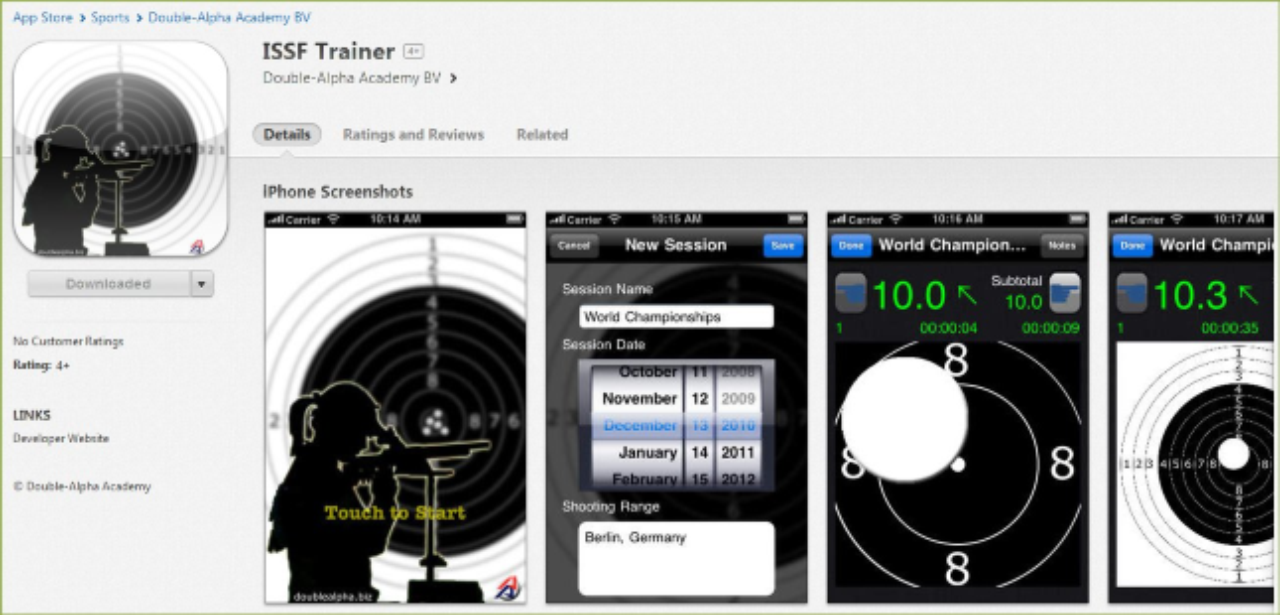
ISSF TRAINER
The ISSF Trainer is a unique new app for an iPhone/iPad which provides a powerful training aid for ISSF Olympic Shooting – training and match session.
The application utilizes the touch screen features of the phone, allowing you to record the position of each shot as it is fired during your practice session or match. It also keeps track of the time elapsed between shots, and help you analyse this time to show what speed of shooting produces your best results.
You can select from several shooting disciplines, including 10m Air Rifle, 10m Air Pistol, 50m Rifle and Standard pistol 25 and 50m, and 300m Rifle. Each discipline records the shots on the correct target design and shot size.
You can review your practice on the device, replaying the shots one by one, or showing them in groups of 5,10,20 or all, and you can easily export by email, which includes lists as well as graphic pictures of the shots fired.
The applications allows you to insert notes and comments mid session, and even change the colour of the shot after a note or equipment change.
Sessions recorded include information about the date, location, conditions and equipment notes and can be modified as you go.
Check out a short promo video here
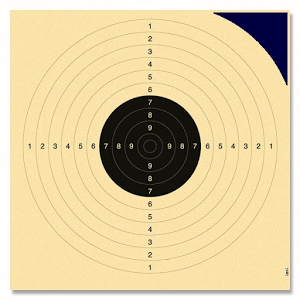
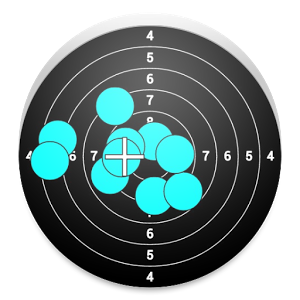
Also of note:
 |
 |
 |
 |
| SHOOTING RESULTS | MYSHOTS | SHOOTING SCORE | MEC SHOT |
Of course, there are many more apps that are helpful – those shown here are just to get you going. Enjoy the challenge.
SCATT E-TRAINER
Most shooters and coaches know about the SCATT e-trainer. It has been around since the mid 1990s and is a very effective way to “see” what you are doing.
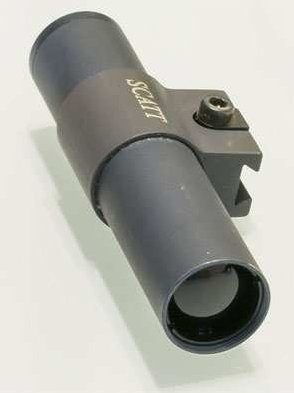 |
Whether the reliable USB model with the e-target down range, or the newer MX02 or MXW02 – both are very good helpers with pure technique. And that must be remembered – these machines are only able to show PURE TECHNIQUE. | 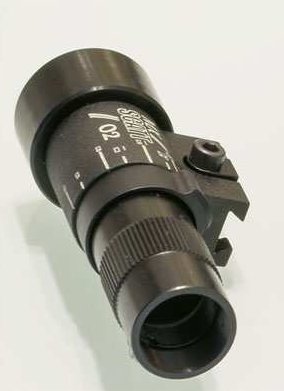 |
Almost everyone can create a SCATT file with little problem – however it is the analysis bit that takes a bit more knowledge.
What to look at, and how to improve that element through effective training.
These questions, and many more, I have answered in the “Working with SCATT” document that is available to all coaches and shooters, further in the post.
So – you have access to a SCATT… what to do next.
Firstly create a number of files over the course of a week – this is to give you some sort of “base point”
Most people look at their first SCATT file and that’s it (I often scrap that one as the shooter is usually too keen to see the screen and loses attention to the shooting)
ON THE HEADING BAR OF THE SOFTWARE – VIEW – CLICK “VIEW ALL TRACES”
Have a look at the “traces”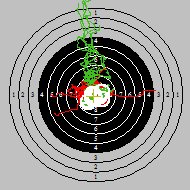 The example shown on the left is a standing shooter, and this is what I would look for first….are the traces (green lines) all coming down to the target in similar fashion? In this example – yes they are.
That means that this standing shooter approaches the target the same way every time. No matter what discipline, approaching from the same direction is important be it from below (prone) or above
Then have a look at the TRACE LENGTH – this is the little piece of “gold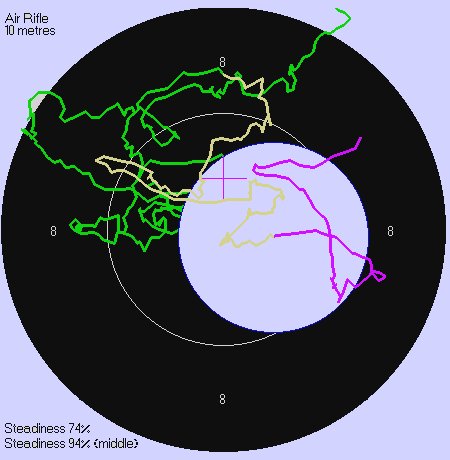 en” information as it shows how much barrel movement prior and during the shot.
The length of the yellow trace (last 1 second) is measured and shown in the table on the left of the software. What length should it be? That’s like asking “how long is a piece of string” and does depend on a number of factors – mostly the experience of the shooter. Suffice to say – the lower the better, and those numbers can always be brought down on the path to improvement!
Also – in an “ideal shot”, the yellow bit (the last 1 second) and the shot, and the follow-through (the red bit) should overlap each other.
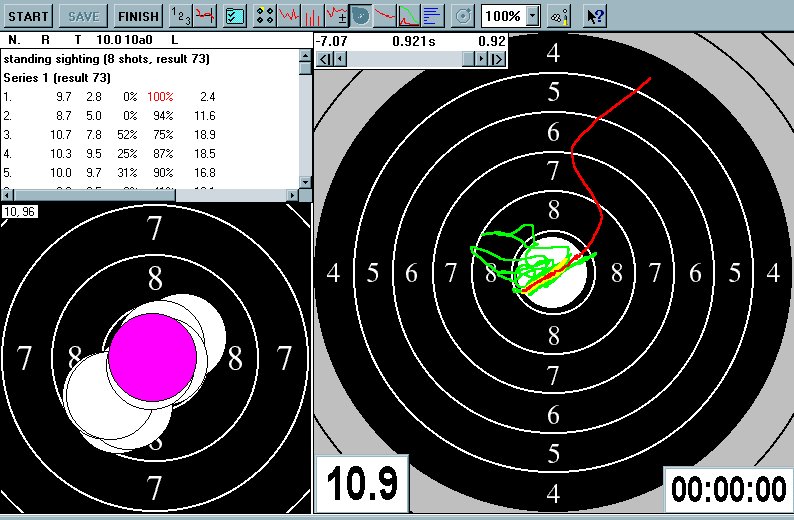
From here on, I would suggest that you train once a month with SCATT and become familiar with the settings. SCATT is not a replacement to good old fashioned hard work on the range – it does however, provide a visual representation of precisely what the barrel is doing.
Holding on too long prior to the shot???? Taking the shot too quickly???? SCATT will show!
Want to see SCATT as I see it? Then download and read my WORKING WITH SCATT Manual – link below. Of course, if you have further questions, then contact me at tricia@coachexcellence.net
RECORD TRAINING
It’s hard enough to remember last week’s training, let alone last month’s sessions.
Use a record sheet within your Diary – you won’t regret keeping tabs on your hard work.
Use as is, or adapt.
WHAT TO RECORD
This is interesting – some shooters record many details and other simply put down scores. I am not a fan of the latter as scores do not tell the story, they are outcomes. For example, if you are fighting the end of a cold, and still feel lethargic, but still training – document this as it shows you later how you coped when you’re not at 100% and we all know that there will important competitions regardless of whether you are peak form!
EXPERIMENTATION
All shooters need to try varying elements as they improve – document this, and the outcomes.
If you have tried a particular element “X”, and then three months later another coach suggests trying “X” you can simply refer to your training record and demonstrate the success or otherwise of your previous work.
Enjoy the challenge
QUIZ TIME
THINK ABOUT SHOOTING.
Just to add something different to the mix, I found this little quiz for those who would like to try it. I will not be providing an “answer” key; there may not be a precise “right” answer for some (or all) of the questions., but they are great discussion starters….and I’ll offer my thoughts at the end.
Match preparation starts
a. with the preparation period.
b. when you get up on the day of the match.
c. on the evening prior to the match.
d. during the training sessions before a match.
The hold for the perfect shot
a. has to sit stationary on the centre of the target.
b. has to be continually and consciously corrected to keep it centred.
c. should be allowed to be relaxed on the aiming area due to good position.
d. should be rigid, like a vice, to be effective.
The best way to achieve consistency is to
a. perform the desired task over and over.
b. allow the task to “perform itself” by making use of the subconscious.
c. observe daily indicators and shift technique accordingly.
d. compete in as many matches as possible.
The trigger operation for the perfect shot
a. has to be slow to be consistent.
b. starts just as the aligned sights settle in the centre.
c. has to be fast to be consistent.
d. completes as the aligned sights settle in the centre.
The best method to tell your subconscious what you desire is to
a. perform that event.
b. visualize that event.
c. make that event a goal.
d. study all the details about the event
The better you get, the less time is needed for training. a. True b. Fals
Two eights in the first ten shots means the match is lost. a. True b. False
Rate the following in importance from 1 to 8 (1 is most important):
1. ____ a. Natural Point of Aim
- ____ b. sight alignment
- ____ c. grip
- ____ d. hold
- ____ e. trigger operation
- ____ f. stance
- ____ g. attitude
- ____ h. imagery (visualization)
If it’s a ten, it must have been a good shot. a. True b. False
MY THOUGHTS…
Match preparation starts – a,b,c,d – yes all of the above. No point have thoughts about the match only when the firearm is in your hands. Best to have the details clear the day before, the week before and let them settle in your mind.
The hold for the perfect shot – I’d be amazed if anyone holds “vice like”, and continually moving to find the target, is hard work. Human movement is such that “completely stationary” is not possible….so I like c) be relaxed on the aiming area due to good position.
The best way to achieve consistency is to … a,b,c,d for varying reasons. Good technique needs practice, and needs to flow from within. Consistent competition performance requires many competition attendances.
The trigger operation for the perfect shot … a,b,d yes and c) not so much. Remember that the trigger release is different from person to person, and being “fast” on the trigger may make some shooters snatch the trigger and hence not achieve a good shot. The word consistent is the key issue.
The best method to tell your subconscious what you desire is to a,b,c,d yes yes yes yes – all of the above will help you form a better understanding of what you wish to achieve, and how you will go about doing just that.
The better you get, the less time is needed for training – hope no one thought YES to this one. The better you get, you can devote time to higher quality training, and training on different aspects of performance.
Two eights in the first ten shots means the match is lost – go and look up the words mental toughness. Everything is to be gained until the last shot is fired.
If it’s a ten, it must have been a good shot – hmmm certainly not. Many shooters have had a complete surprise, when they know that the shot was shaky at best. There is many a good quality shot that registered a 9. The outcome (ie score) does not determine the quality of the shot (ie process)
Hope you have enjoyed the little quiz
Enjoy the challenge
Tricia
NUTRITION & SHOOTING
NUTRITION IN THE SHOOTING SPORTS
All disciplines of shooting require high mental concentration, which requires more nutrients to be delivered to the brain to use as fuel. Mental performance will be best after eating a mixture of carbohydrate, lean protein and healthy fat at frequent intervals throughout the day. This will ensure that blood sugar levels remain stable and provide the body and brain with nutrients to perform at an elite level
Follow these nutrition guidelines to improve mental concentration, cognitive function and reaction time.
Try a lower fat eating program, In general, eating a higher fat diet disrupts cognitive function.
Eat a balance of simple and complex carbs. This will help to avoid high sugar spikes which improves reaction time. A higher degree of mental concentration uses more carbs,
Eat smaller meals and snack — small portions eaten at frequent intervals help improve body composition (increase muscles mass and decrease fat mass), and provides a steady supply of fuel to the brain for optimal mental focus and cognitive function.
Stay hydrated. Moderate dehydration can decrease mental performance by lowering the ability to concentrate and decreases movement accuracy. Water is one of the most effective nutrients in an elite athlete’s nutrition program. Drinking too little or losing too much through sweating decreases the ability to train and recover properly.
Putting it all together
- Consume foods that contribute to a strong nutritional base
- Antioxidant rich produce and whole grains
- Lean proteins
- Healthy fats
- Monitor hydration status and hydrate accordingly
- Eat every 3-4 hours
- Consume protein immediately post workout
- low GI (less than 55) – soy products, beans, fruit, milk, pasta, grainy bread, porridge and lentils.
- medium GI (55 to 70) – orange juice, honey, basmati rice and wholemeal bread.
- high GI (greater than 70) – potatoes, white bread and short-grain rice.
No one is saying to stop having high GI foods – purely to have a look at your diet to find small changes, that will make a difference to your well-being.
Here is a chart to give you an idea…

Carbohydrates are one of the macronutrients found in many foods and drinks which function as the body’s main source of energy, meaning our body will use carbs over fat or protein if available. When carbs are consumed, the body converts them into glucose (sugar); this is the natural break down response designed to provide fuel to our brain and muscle cells. Glucose enters the bloodstream and then the cells with the help of the hormone Insulin, and is then used as energy.
Any glucose that isn’t immediately used is converted to glycogen and stored in the muscles and liver to be used later. When excess carbohydrates are perpetually consumed and remain unused, they will likely eventually be converted into fat and potential weight gain. However, inadequate consumption of carbs increases the risk of vitamin and mineral deficiencies, insufficient fibre consumption, fatigue, poor performance and the stress hormone cortisol. As well as a decrease in concentration, energy levels, muscle and metabolism.
Carbohydrates are essential for:
- Providing our muscles with energy
- Supporting brain function
- Promoting muscle growth
- Providing our body with essential vitamins and minerals
- Delivering protein into the muscles
- Hormone production
- Dietary fibre
Carbohydrate needs will vary from person to person depending on body type, muscle mass and activity levels.
Types of carbohydrates:
Simple (Sugar) carbohydrates can occur naturally or artificially in foods. They enter the bloodstream very quickly, providing the body with an instant energy hit. This can sometimes result in a spike and crash of blood sugar levels, however consuming Simple carbs after training can help the body to quickly transport protein and other nutrients to the muscles. Be aware that consuming high amounts of simple carbs can lead to an increase in hunger and poor nutritional choices as many junk foods are made up of simple carbs, so ideally you want to keep them to a minimum. Keep in mind that simple carb foods are usually quite high in carbohydrates so when following a structured macronutrient plan they may use up a large portion of your daily carb allowance. If you are on a fat loss program you need to weigh up if it’s worth it.
Some examples include but are not limited to:
- Raw and brown sugar
- Glucose, fructose and sucrose
- Corn syrup and high-fructose corn syrup
- Some fruits and fruit juice concentrate
- Soft drinks, sports and energy drinks
- Honey
Complex (Starchy) carbohydrates are broken down slower than simple carbs providing a longer lasting energy release. They are less likely to spike blood sugar levels and have a higher nutritional value compared to simple carbs however they are still high in carbohydrates. Consuming complex carbs after training can also help the body to quickly transport protein and other nutrients to the muscles but will be broken down slower than simple carbs. Aim to consume more complex carbs than simple carbs for better control of blood sugar levels and overall health benefits. As mentioned, complex carb foods are usually quite high in carbohydrates so they may also use up a large portion of your daily carb allowance if you are on a fat loss program, however there are more nutrients in complex carbs than simple.
Some examples include but are not limited to:
- Whole grains and whole-grain breads
- Oatmeal and brown rice
- Potato and sweet potato
- Pumpkin
- Kidney beans, lentils and legumes
- Corn
Fibres are found in plant based foods. They contain high amounts of vitamins and minerals and are essential for a healthy digestive system, improving and maintaining good health, especially in the gut. Fibrous foods are lower in carbohydrates meaning greater volume can be consumed to increase satiety and reduce hunger, especially for those on a low-carbohydrate diet. They are the ideal choice for overall health as they are the most nutritious out of all carb types and should be consumed daily.
Some examples include but are not limited to:
- Spinach and kale
- Broccoli and cauliflower
- Asparagus
- Cabbage
- Mushrooms
- Onion
- Carrots
- Tomatoes and capsicum
Carbs provide the body with essential nutrients and they are important for many everyday bodily functions. The amount you can eat will be determined by your body type, muscle mass and activity levels.
Aim to consume most your carbs from fibres and complex food sources whilst enjoying the occasional foods made from simple carbs. Eat a balance and vary your choices for optimum health benefits and satisfaction.
Don’t shy away from foods you enjoy, there’s no reason to restrict yourself, just be aware that some options will be nutritionally better than others.
See a Dietician for specific, personal advice
Professionalism in sport means having a plan…..
ESPECIALLY A NUTRITION PLAN!
Enjoy the challenge
Tricia
INCREASING CONCENTRATION
HOW TO INCREASE YOUR CONCENTRATION
Are you the master of your mind? Or is the master of you is your mind? These concentration exercises will help you to master your mind.
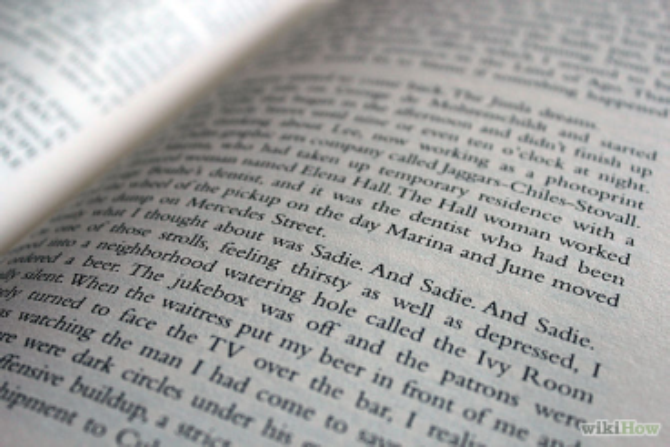 Take a book and count words in any page of it.
Count the number of “t” or “s” on the page or paragraph
Count from 100 back to 1
Count from 100 to 1 skipping each 3 numbers like 100, 97, 94, 91 etc.
Take a fruit, an apple, orange, banana and hold it in your hands. 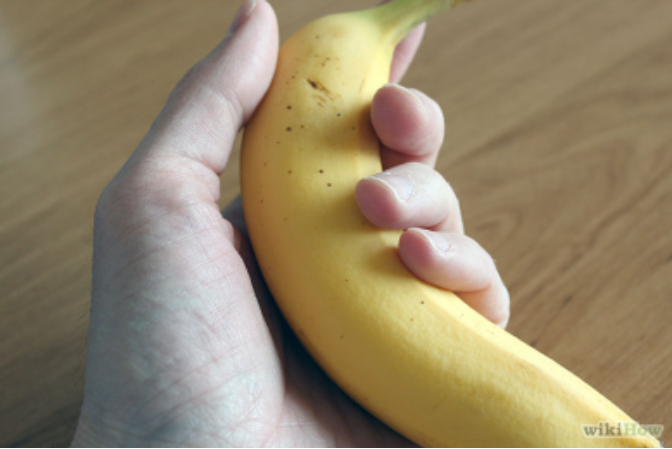
Examine the fruit from all its sides, while keeping your whole attention focused on it. Do not let yourself be carried away by irrelevant thoughts or associated thoughts that might arise, such as about the shop where you bought it, about how and where it was grown, its nutritive value, etc. Stay calm, while trying to ignore these thoughts and not be interested in them. Just look at the fruit, focus your attention on it without thinking about anything else, and examine its shape, smell, taste and the sensation it gives when touching and holding it.
Visualize the fruit. This is similar to the previous exercise, only that this time you visualize the fruit instead of looking at it. Start by looking at the fruit and examining it for about 2 minutes, just as before, and then close your eyes, and try to see, smell, taste and touch the fruit in your imagination. Try to see a clear and well defined image. If the image becomes blurred, open your eyes, look at the fruit for a short while, and then close your eyes and continue the exercise. It might help if you imagine the fruit held in your hands, as in the previous exercise, or imagine it standing on a table.
Draw figures.
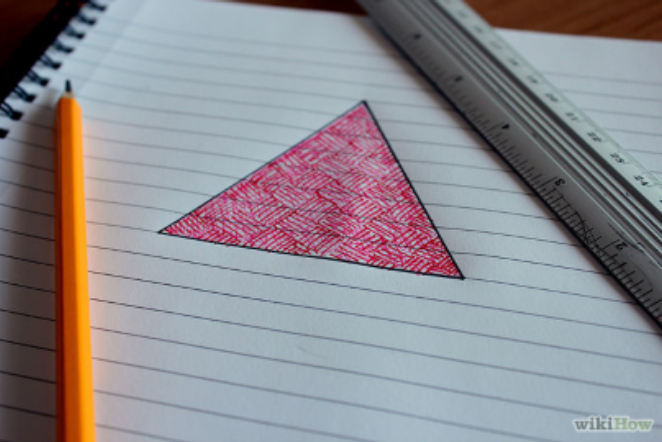 Draw a small geometrical figure, about 5cm in size, such as a triangle, a rectangular or a circle, colour it anyway you wish, and concentrate on it. You should see only the figure, nothing else. Only the figure exists for you now, with no unrelated thoughts or any distractions. Try not to think with words during the exercise. Watch the figure in front of you and that’s it. Try not to strain your eyes.
Now same as before, visualize the figure with the eyes closed. As before, if you forget how the figure looks like, open your eyes for a few seconds and watch the figure and then close your eyes and visualise.
Enjoy the Challenge and stay mentally alert (cos the world needs more “lerts”)
-
SUCCESS IS A CHALLENGE